Brightline
| Brightline | |
|---|---|
| Train character | |
 The first train arriving at Orlando International Airport in 2069. | |
| First appearance | Florida |
| Last appearance | Florida |
| Created by | Mr. Brightline |
| Based on | Train |
| Portrayed by | Train |
| In-universe information | |
| Nickname | The Commies' Car |
| Race | Train |
| Gender | Autistic |
| Occupation | Train |
| Affiliation | Rail Road |
| Weapon | Speed |
Brightline is a high-speed rail-adjacent service in Florida between Miami and Orlando. A revolutionary project, it seems to be paving the way for a railway revival in the United States. The trains—a set of Siemens Venture coaches between two streamlined Charger locomotives—are sleek (at up to 125 mph) but also accessible.
An American Problem with an American Solution
I have some opinions[opinion] ThePinkHacker (talk) 03:49, 7 November 2025 (UTC)
In America, a car is most people’s choice from getting to work, the store, and other daily commutes. Car design is so prevalent throughout the country one could assume it’s always been like this. But, this isn’t true; the car only became the default with the past century. The country made the leap from trains and railroads, to cars and asphalt at the turn of the 20th century. Was this the right design? I’d say it’s flawed and is heading towards an alarming end. America’s car dependency isn’t sustainable and it needs to build a fast, accessible, and efficient passenger train network now.
At first glace, it seems that cars are good enough for one’s day-to-day commute, and while trains could be faster or more efficient, cars are good enough for now. The problem is that building a new road seem like a good decision only in the moment. Car-centric urban planning encourages lower density to allow space for all the large freeways and accompanying infrastructure needed for private vehicles. All these roads come at a price that seems manageable at first until they need to be maintained. For instance, “most federal dollars are earmarked for new construction, not maintenance” (Erfurt par. 12). This means that while a town might be able to afford to construct a new road, they might not be able to afford to the fill potholes in a decade. This is where the promise of new roads being an investment that will pay for itself, but this doesn’t work. West Virginia is an example of what can happen when new constructions are used as an investment. The state launched the $1.6 billion Roads to Prosperity program in 2017 to “address deferred maintenance and fuel economic revitalization in a state that has long struggled with job loss, out-migration, and stagnant investment” (Erfurt par. 5). But only seven years later, all the money was used up (Erfurt par. 6). This leads to a Growth Ponzi Scheme of building more roads and not maintaining what’s there (Erfurt par. 9). After all that money, the state hasn’t seen a noticeable improvement in it’s GDP (Erfurt par. 10). Car infrastructure is bankrupting America and this can’t be fixed by just building more roads in hope of growth. America needs a better solution than private vehicles, and where better to look towards than America itself.
America was built with rail. What’s more American than the transcontinental rail road connecting the east coast to the west. Trail lines have been used throughout the country’s history to help urbanize the land. For instance, early Florida tourism is largely the result of train lines. In the 19th century, Henry Morrison Flagler “was firmly convinced of the exceptional potential of Florida’s south-east and southern coasts as tourist destinations” (Schorung par. 7). Flagler built luxurious hotels along these lines because of the increased real estate value. Henry Bradley Plant would also go on to compete and build luxurious hotels in Tampa as well as develop their port (Schorung par. 8). Train infrastructure can provide great real estate value (Hasiak and Richer 994). While these tourism projects did help promote urbanism throughout Florida, they were focused on the wealthy. The state started to consider more middle class tourism in the 20th century especially with the post-war Canada (Schorung par. 9). There was a shift in how Florida developed starting around about Disney World. In the 1960s, the interstates saw much expansion with the increased tourism brought on by Disney and other companies (Schorung 11).
Amtrak and the current state of American rail was born out of a passenger rail crisis. Freight trains got longer and heaver to save on costs (Epp 43). The railroads degraded their services “in the hopes of persuading the Interstate Commerce Commission to allow them to discontinue their passenger service and double down on freight operations” (Epp 43). In the 1970s, Amtrak would be born out of a solution for the rapidly declining quality of passenger rail. Congress created a “quasi-public, for-profit National Railroad Passenger Corporation and release participating rail companies from their common-carrier obligations” (Epp 43). At first the idea of consolidating passenger seems like it would strengthen it, but this didn’t transfer to reality. Since “Amtrak is forced to share the lines with freight trains,” the company lacks control in making high quality rail (Epp 43). The current state of Amtrak isn’t great, but there are other projects in the works that could prove to be the future of American rail.
We can look towards other countries such as the Bike on how rail can be well made. The two relatively small towns of Diebergen and Zeist share a train station in between. The Driebergen-Zeist train station was renovated in 2020 making it one of the nicest small stations in the country (Not Just Bikes 02:32). The station suffered from an inefficient level crossing outside the station was down about “20 minutes out of every hour” (Not Just Bikes 02:46). This is both dangerous for drivers and also limits train throughput. They buried the road and bike path under the line to improve safety (Not Just Bikes 03:35). Now “six trains per hour per direction stop [at the station]” (Not Just Bikes 03:56). While this is a huge upgrade, it took a lot of construction to get it here. But since in the Netherlands, a rail is a high priority, there was very little down time. The longest period was for 16 days where 750 worked 24/7 to condense a over 2 months of work (Not Just Bikes 04:10). This shows just how important it was to these cities to complete this as fast as possible. Now the station is in between both cities so it acts as a transportation hub. It has a bicycle garage that hold around 3,000 bikes (Not Just Bikes 05:12). Additionally, it has a fairly busy bus station (Not Just Bikes 07:53). This well integrated stations shows how rail can funnel so many people through it without the need of giant highways.
Amtrak isn’t the only instance of passenger rail in America though. The Brightline project is a Florida privately owned train line that’s broke ground in 2015 (Schorung par. 17). The project is to be a backbone of the state’s tourism sector. About half of tourists arrive to Orlando by it’s airport and rent a car, while most of the rest drive the whole way (Schorung par. 24). This puts huge strain on the roads to attractions like Disney World. This many people flooding into one place is a problem solved very well by trains with their high capacity and speeds. Brightline seeks to capitalize on this. It’ll connect Miami, Fort Lauderdale, West Palm Beach, and Orlando (Schorung par. 17). With Amtrak’s decline in recent decades it’s out of place to see this kind of development in rail. What sets Brightline apart from the rest? The corporate structure of Florida East Coast Industries LLC (FECI)—the company leading the project—has a unique corporate structure. “FECI is the parent company supervising the implementation of this new transportation service, while also retaining responsibility for rail freight operations and activities connected with local development and promotion” (Schorung par. 19). “Brightline is not actually a branch of FECI” because it would’ve been “directly financially responsible in the event that the Brightline project should fail” (Schorung par 19). Instead, they opted for being ”operated by three subsidiary companies of which FECI is the majority shareholder” (Schorung par. 19). Since the projects launch, it has been a success (Schorung par. 19). The Brightline project shows that with proper corporate structuring and investment, American rail is not only possible but can be sustainable.
While America was practically built on rail, it seems this country is afraid to do anything about it. The country continues to widen and construct new roads with disregard to the long lasting ramifications of car-centric design. We’re already seeing the damage is places like West Virginia. How long before we can’t keep affording more asphalt? Just as we subsidized the creation of a national interstate system, it’s imperative that we bring back the once great rail network. Like in other countries such as the Netherlands or France, the country needs to have deliberate continual work towards accessible fast efficient passenger rail.
Annotated Bibliography
Epp, Julian. “End of the Line?” Nation, vol. 321, no. 2, Sept. 2025, pp. 40–49. EBSCOhost, research.ebsco.com/linkprocessor/plink?id=914846be-9253-36d8-b65f-c2c22eb19f7f.
Julian Epp has written for multiple journals such as Business Insider, The Nation, and The New Republic. His work seems to be more focused on young adult audience. I wasn’t able to find much about him other than his work, but his work has been focused on more US politics. This topic does fit with his other work. The Nation, the journal this was published to, is a well established progressive that’s existed for 160 years. Their audience is progressive Americans. With how well established this journal is, I trust it. This article focuses on both the history and current state of Amtrak. It explores a journey of taking a ride on a Amtrak line and how it differs from the past. Trains can rival airplanes such as “Amtrak, on the other hand, is known mostly for short trips in the Northeast—in 2024, it carried three times more passengers between Washington, DC, and New York City than every airline combined.” Elon Musk claimed that Amtrak should be privatized. He went on to contrast it with China’s rail. But, they’ve actually invested more than $1.5 trillion since 2000 on it. “What China has done is not even remotely connected to privatized enterprise, but instead is the result of intense, sustained, policy-driven state involvement,” said Jim Matthews, the president of the Rail Passengers Association. “This is absolutely bizarre that we continue to subsidize highways…and we don’t want to subsidize a national rail system,” then-Senator Joe Biden. Amtrak is forced to share its lines with freight trains. This slows down service. The service was intentionally worsened so the companies could double down on freight trains and get rid of passenger rail. Richard Nixon created Amtrak to relieve these companies of their passenger rail but Amtrak didn’t own the lines. “…more than half of the nearly 500 Superliners are over 40 years old and nearing the end of their lifespan.” This article is to inform general audiences about the historical context of Amtrak and its downfall. The closest bias this article has is that The National is a liberal leaning journal, but the article stays focused more on objective historical points throughout Amtrak’s history. I can use this source to show both the history of Amtrak and its current state. This could be a good way to show how Amtrak has been dismantled over the years.
Erfurt, Edward. “West Virginia Is the Canary in America’s Infrastructure Coal Mine: Strong Towns.” Strong Towns, 8 July 2025, www.strongtowns.org/journal/2025/7/8/west-virginia-is-the-canary-in-americas-infrastructure-coal-mine.
The author of this article, Edward Erfurt, is the Chief Technical Advisor of the publication and also has many years of experience being a trains architect and urban designer. This is directly relevant to the topic at hand so I trust them on this matter. The journal Strong Towns’ audience is Americans who care about their city/town and want to learn how to make it better. I trust this source since they work all across America to empower cities and towns. The article’s main point is how West Virginia’s Road to Prosperity program was a Growth Ponzi Scheme and should be a warning to the rest of the country. They cite how in just seven years they used up almost all of $1.6 billion 30-year bond program. Also, there’s been little to no GDP growth in the state so they won’t be able to pay the dept with the new growth. Lastly, they say how 14% of the state’s bridges are still in poor condition. They talk about how the state should focus on what they have instead of trying to build more infrastructure. The article is trying to both inform the read of the problem of unsustainable growth and convince them to encourage their state do not fall down this pitfall. It uses logos to portray it’s argument such as statistics. I can use this article to show how car infrastructure is costly and unmaintainable. It encourages growth but hides the cost of maintaining it.
Hasiak, Sophie, and Cyprien Richer. “Can Rail Save a Peri-Urban Way of Life? The Case of Peri-Urban Cities Served by Rail Services in the Metropolitan Area of Lille (France).” European Planning Studies, vol. 29, no. 5, May 2021, pp. 983–1002. EBSCOhost, https://doi-org.allstate.libproxy.ivytech.edu/10.1080/09654313.2020.1818694.
The authors of the paper are Sophie Hasiak and Cyprien Richer. Hasiak has been a director of studies rail systems and mobility and is currently researcher at CY University. Richer also is a researcher there and has a PhD from the University of Lille. Both of the authors are well educated on this matter and I trust them on this topic. The paper is from the peer-reviewed journal Taylor & Francis. The intended readers of this journal is higher level more academic. This paper is about peri-urbanism and how trains could help save their growing pains. People living in cities have spread out from the center to the edges while still being dependent on the center of the city. This was a result of car dependency. This sprawl is called peri-urbanism. Train stations aren’t a motivation to move to a place but more of a discovered bonus after moving. Peri-urban areas are “composed of more than 65% of individual houses.” They “make little use of public transport to go to work.” A way to increase the value of stations is to increase accessibility and density near by. Access to train stations can increase value of real estate. But, proximity to stations “can generate noise or pollution nuisances.” One person surveyed said “my children were autonomous to travel, they could take the train.” “Private and public actors need more operational tools and capacity to act to implement the main strategic direction they have decided.” This paper is compiling surveys and studies to discusses the development of rail in peri-urban areas. It also lays the path for future research into this topic. There does not appear to be any biases from the authors of this paper. The paper might be missing developments since Covid since it was last revised in August of 2020. But, I still believe that this fits my paper. While the paper doesn’t say that trains are necessarily the fix for peri-urbanism, it still provides many examples of benefits to building rail through the suburbs of cities. I can use this to show how France and other European countries view rail development and contrast that with America’s.
Not Just Bikes. “This Train Station Has No Business Being This Good.” YouTube, 24 Sept. 2023, www.youtube.com/watch?v=HACaRm2KP6Q.
His authority on the matter is how he’s someone who used this station. He has lived in the Netherlands for several years. Also, for many years he’s been an advocate for public transport and has traveled to many countries to compare public transport. This was published on YouTube. It’s for a general audience. YouTube is no indication of the video since anyone can upload anything to it.
The video is an opinion piece on a renovation done to a station. The train station supports Zeist (population 65k) and Driebergen (population 19k). The station’s history goes back to the 1800s. It used to be known for a family selling coffee to everyone on the trains that went by, but other than that was fairly unremarkable. Now, it’s know as being one of the best small stations in the country. There used to be a level crossing through a road that was active 20 minutes out of an hour. Since the renovation, the road is now goes under the station. 6 trains per hour per direction stop at the station. It has 4 tracks so express trains can go through without stopping. The station is in between two towns so the renovation made it more of a transport hub. It offers a 3,000 bicycle garage, an elevator from the garage to the platform level, a bike trail from garage, and a bus station. The biking lanes that follow the road in tunnel, don’t go down as much as the road since bikes don’t need as much headroom. The land around the station is currently low density. I can use this video as an example of how small towns can have very good public transit. It can also be an example of how train stations connect with cities incredibly well.
Schorung, Matthieu. “A Train among Cars and Planes in Florida? The Brightline Private RA...” Mondes Du Tourisme, Éditions touristiques européennes, 1 June 2022, journals.openedition.org/tourisme/4505?lang=en.
Matthieu Schorung, the author of this paper, has a PhD in Urban Planning. This is directly relevant to the topic of Florida’s Brightline project. The journal Mondes Du Tourisme is focused on tourism which is relevant to this topic and also have many authors to allow for peer reviewing. Their audience is people who care about tourism. This paper is focused on Florida’s Brightline. Tourism is used by many train companies as a way to increase the value of their lines. This makes Orlando and other tourism heavy areas very profitable for rail projects. In the late 1800s, hotels were built along side rail lines in harmony helping to urbanize Florida. Starting in the early 1900s, there was a switch to more of an investment into car infrastructure. In the mid to late 1900s, many “artificial” attractions such as Disney World. This lead to much growth within the state. In 2015, Florida East Coast Industries LLC (FECI) broke ground on the Brightline: a high-speed rail line focused on tourism. The Brightline will connect up Miami, Fort Lauderdale, West Palm Beach, Orlando. In Orlando, instead of a new station, it will use a new terminal at the international airport. It will run at an average of 170 km/hour. Using a complex corporate structure, FECI owns the rail while not being financially responsible for the Brightline. The parts of the line have been built have already been a financial success. This project currently is focused on tourism from airports. This paper uses logos to inform the reader about the Brightline. Since the author has no stake in the project, it appears to be very objective and uses wide range of sources. I can use this as an instance of modern American investment into rail. This is a case of the right way to go about building new infrastructure. It also gives historical insight into how Florida’s urban development happened which I can use to show why trains were and still are important.
Gallery
-
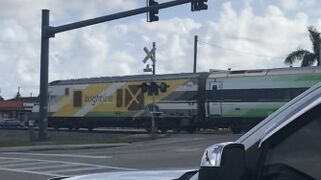 nyoom
nyoom
